


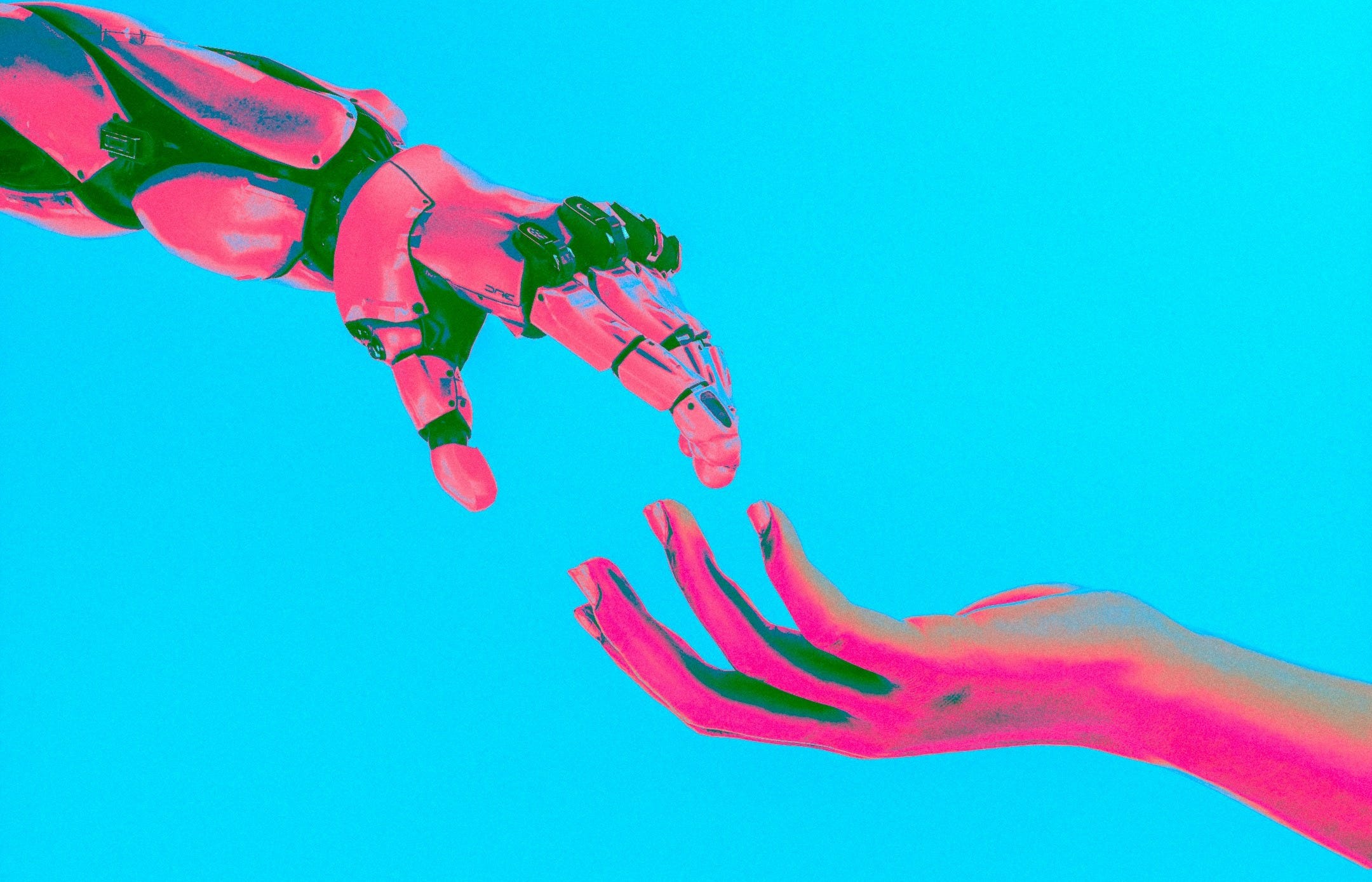
What are your thoughts on AI?
I’ve been getting asked that question for a few years now. It would usually come during an interview about my work founding Girls Who Code, so I always welcomed it as an opportunity to talk about how technology can be a critical partner for both social good and unlocking economic mobility for marginalized groups. You know the story because it’s the story of how teaching over 860,000 girls to code fundamentally reshaped the tech pipeline and allowed girls to march into the middle class through CS and engineering jobs they were previously shut out from.
Recently, there’s a new variant of this question that everyone is asking me: What are your thoughts on women and AI?
This conversation usually comes up while talking about the work Moms First is doing to fight for childcare and paid leave for America’s moms who have been left behind by bad policy and an economy that runs off their free labor. It’s also usually couched in between examples of powerful women telling other women to “get on board or get left behind!” and the instant backlash to that call to action by other women who are not buying what they’re selling.
Last week, Emma Grede and I talked about this question. She’s all in on AI. To her, it’s a tool that could be harnessed to bring positive change for women and people of color. I don’t disagree with her about the potential. But I told her the truth as I see it: work has never worked for women and people of color, so don’t ask us to get excited about the future of work before you’ve fixed the present of it.
Women get told constantly that our hesitation around AI is nothing more than a confidence problem. A skills gap. A vibes issue we need to therapize our way out of. Get a course. Get a mentor. Get over it. Meanwhile the men (and yes, women) saying this to us are, more often than not, the same people who built or profit off of workplaces that already don’t work for us.
Before I tell anyone to sign up for “the next big thing,” you better believe I’m reading the fine print. Once a lawyer, always a lawyer. A contract hates to see me coming.
So this week I want to talk about a piece of research that finally gives a name and receipts to the hesitation many women hold. It’s called The AI Judgment Penalty, a study out of Code For Good Now, led by founder Zehra Chatoo, with StudioAAPT and Potentia Insight.
Here’s the design, and it’s a smart one: they took a nationally representative sample of a thousand UK adults and showed every single one of them the exact same AI assisted CV for a marketing role. Same experience, same bullet points, same numbers, same everything. The only thing that changed was the name at the top. Half the group saw Emily Clarke. Half saw James Clarke. Everyone was told, upfront, that the candidate had used AI to help build the CV.
And I bet you can predict the results a mile away. Respondents were twice as likely to question Emily’s competence as they were James’s, for using the exact same tool in the exact same way. Emily was 22% more likely to have her trustworthiness questioned. When men use AI, evaluators question their effort. When women use it, they question their integrity. Same input. Same output. Different verdict, based entirely on their perceived sex.
And there’s an added layer to this stinky onion. The steepest gap in ratings between Emily and James didn’t come from boomers or Gen X, but rather Gen Z men, the generation raised alongside these tools, and the demographic everyone assumes will usher in a more equitable future simply by virtue of having grown up online. Of male Gen Z, 97% respondents rated James’s CV as “strong,” while only 67% said the same about Emily’s. Familiarity with the tool did not buy Emily fairness from the people who supposedly understand the tool best.
This is the part where I say I told you so (lovingly).
As the study highlights, Harvard Business School research has already identified fear of judgment as one of the top three reasons women hold back from adopting AI, alongside trust and ethics, which, by the way, are exactly the qualities this technology needs more of, not less. This study now proves those fears are not unfounded. Women with more AI knowledge are less likely to adopt it, not more, because they fundamentally understand that the tool does not exist in a vacuum. As Chatoo puts it plainly in the report, you cannot upskill people out of structural bias. You can put every woman in America through a prompt engineering bootcamp and it will not change the fact that the system is rigged against her before she even opens her laptop.
To be clear, I am not anti-AI. I’m not asking anyone to cancel their Claude account. I think the tools are here to stay and I think there is real opportunity buried in them. That’s why students at Girls Who Code are learning how to responsibly use AI to solve the biggest problems facing society. It’s also why Moms First built Paidleave. AI, a first of its kind tool that uses generative AI to unlock the paid leave benefits that parents are owed.
But I am done being told that women’s caution is the problem that needs solving. Their caution is backed by data. It shows up in a controlled study with a thousand people and a swapped name at the top of a resume. Women who recoil at being told to get onboard are rational actors acting rationally, they are not being difficult or contrarian because it’s fun.
Before we have an honest conversation about the future of work in the age of AI, we need to have an honest conversation about the present of work for women in this country in 2026. Late stage capitalism did not build a fair floor for us before AI showed up, and AI is not going to build one for us now, not on its own, not without leaders forcing the issue.
We are being asked to lean into something that penalizes us for the exact behavior it rewards in men. It’s a tale as old as time that rears its ugly head in every chapter of a woman’s life and career: the pay gap, the “broken rung”, the paid leave usage gap, the motherhood penalty, the caregiving gap, the midlife penalty, the ill-named “ambition gap.” And now, the AI judgement gap. Damned if we do, damned if we don’t. Rinse and repeat.
Fix the floor first. Fix childcare, paid leave, and pay inequality. Then, fix how AI assisted work actually gets evaluated, fix who gets the benefit of the doubt, fix the assumption that a woman who used a tool must be hiding a deficiency while a man who used the same tool was simply being efficient.
Do all that, and then we can have an honest conversation about the future.
Until then, let’s stop telling women to get excited about the barriers in front of them.
While you’re here…
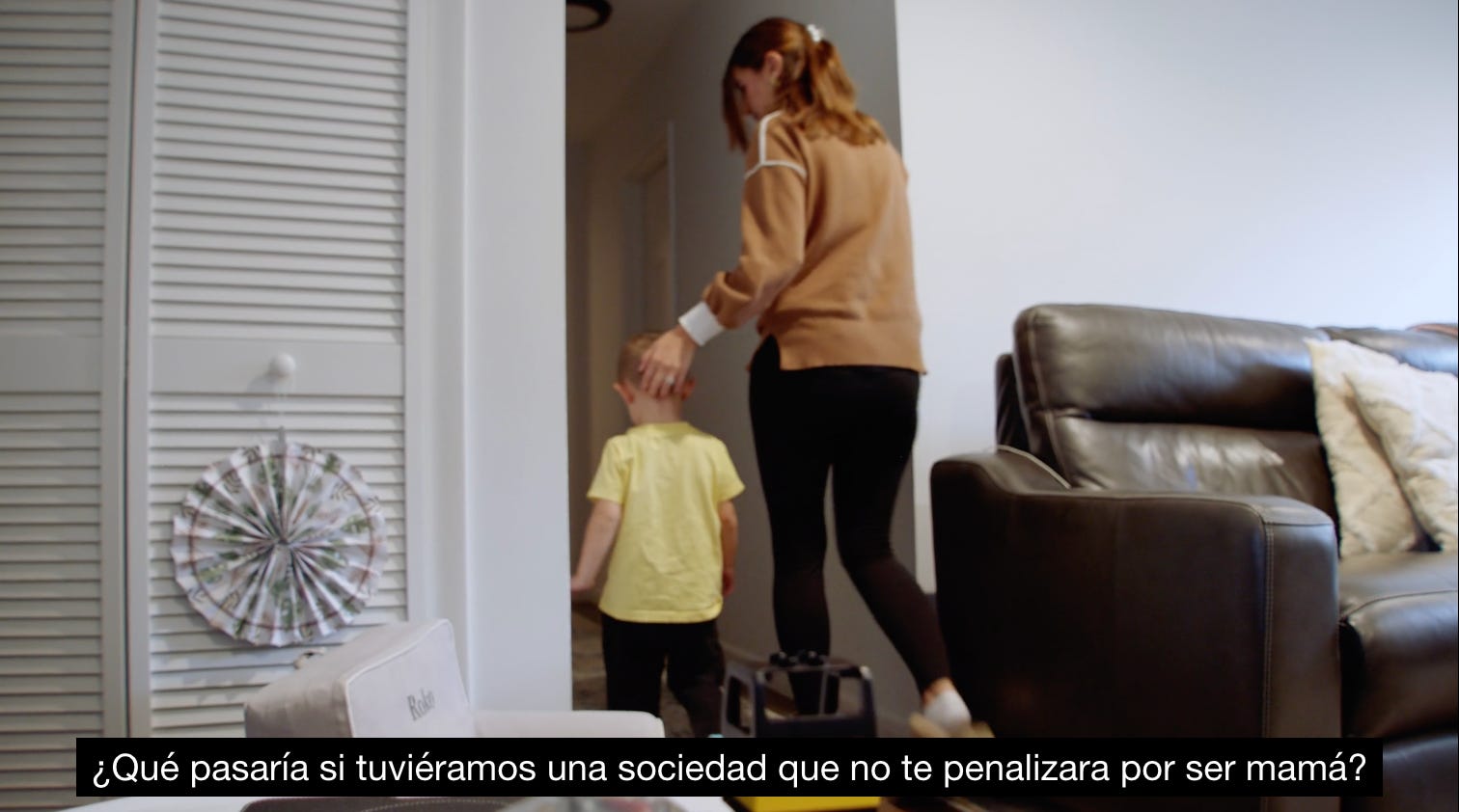
Guess What’s Now Playing in Five Languages (and Ready to Go Global)
No Country for Mothers just got a lot easier to share.
The film is now available with Spanish, French, Italian, Chinese, and Portuguese subtitles. Sign up to host a watch party and bring more people into the room: your abuela, your best friend from grad school, the families on your block.
This isn’t a small thing to us. Motherhood doesn’t happen in one language, and neither should this movement. Need a specific language available for your screening? Email us at hello@momsfirst.us and we’ll help you get set up.
And if you’ve been dreaming bigger: moms in Belgium, Nigeria, Canada, Austria, Denmark, South Africa, and the UK have already reached out to host watch parties of their own. If you want to bring this film to your community outside the US, we’ve got you covered. Just reach out to hello@momsfirst.us and let’s make it happen.
In case you missed it…
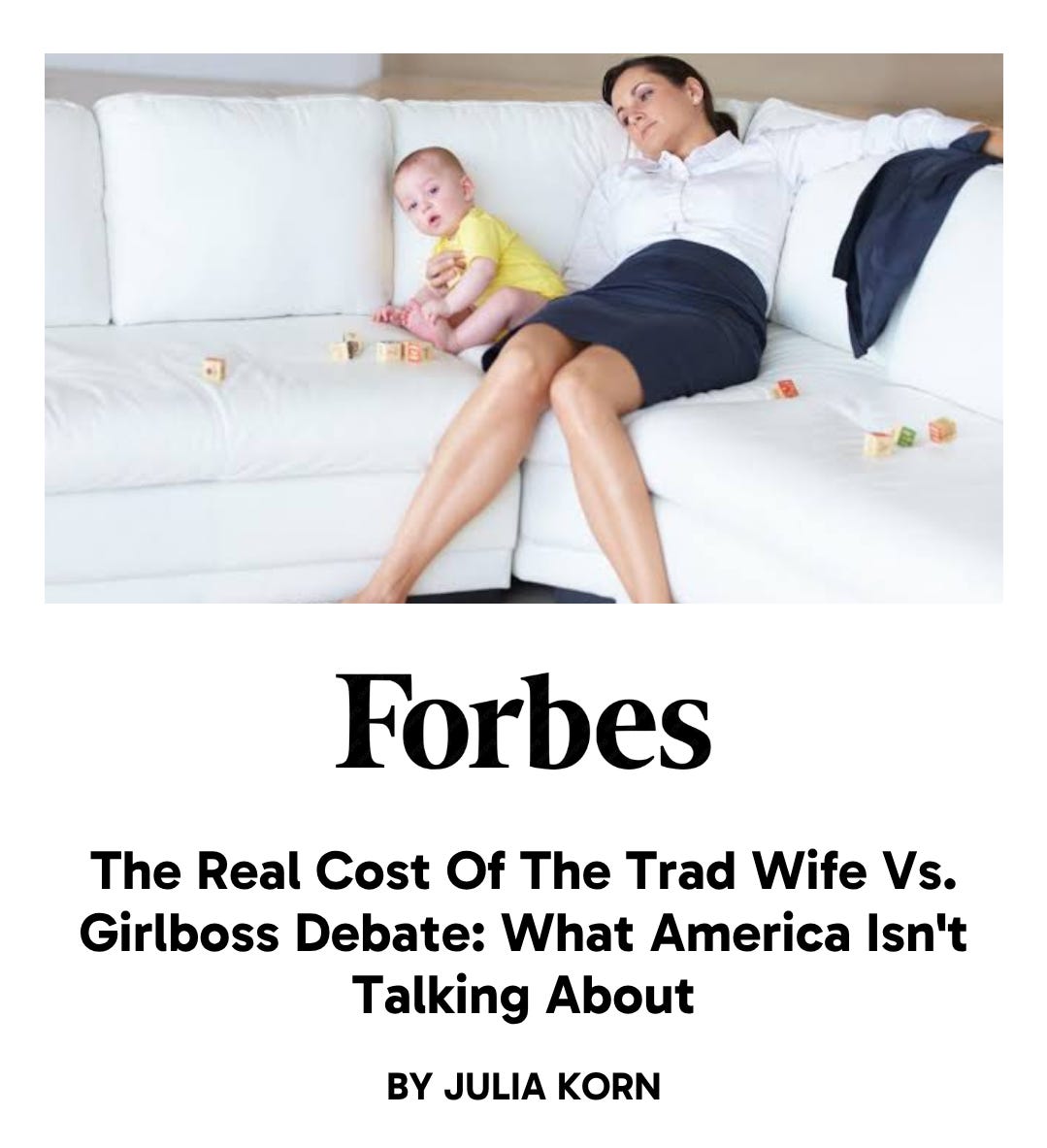
Who else is sick of this fake choice we keep forcing on moms? Tradwife or girlboss. Stay home or lean in. Pick a side.
I spoke with Julia Korn at Forbes about this. Here's the real question nobody's asking: can women actually afford either choice? Because the data says most aren't choosing…they're managing.
We're one of the only wealthy countries on earth with no paid leave, no affordable childcare, no real support for families. No matter what you pick, you're on your own.
That's the crux of my film, No Country for Mothers. Moms are not broken. The system is. And we've been too divided to fix it.
Thank you to Julia and Forbes for digging into this with us. You can read the full piece here!
Last week’s Heres the Thing
My Conversation with Emma Grede
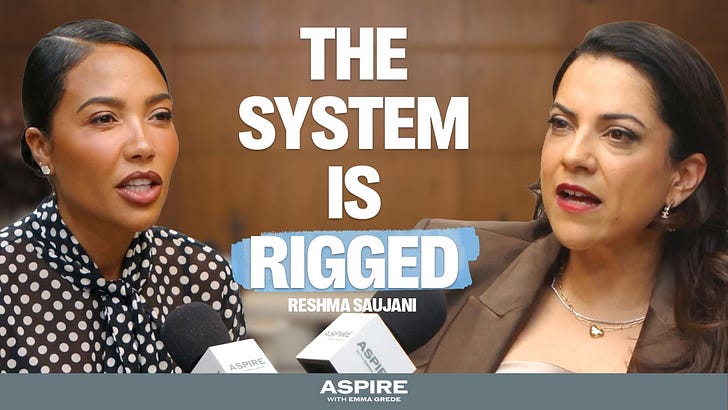
As I was working on my documentary No Country for Mothers, I reached out to a lot of powerful voices with wildly different opinions about women, motherhood, progress, and power. I invited them all to talk with me and have a conversation about our differences in order to find our common ground. I wrote to women from across the aisle, women who ran in en…
Post Photo by Cash Macanaya on Unsplash
One of the ways to fix biases and structural differences is to get involved in building the frameworks for responsible AI and reducing the bias. We have an opportunity to shape the AI world and need to be at the table. And to use AI to create more transparency and tools like you are doing with the PaidLeave.AI. We can with AI, create tools and the world we want by getting involved. Not by sitting back because of the fear of being judged.
Tale as old as time.