


Last year, 500,000 women left the workforce. The number one reason for their exodus? A lack of accessible, affordable child care. A problem we know how to solve and have chosen not to.
I can’t help but think that if half a million men were kicked out of the workforce because of a structural issue with a clear, proven solution, there would already be a special government task force assembled to resolve it. That may sound cynical, but what else am I supposed to believe after the government recently swooped in to sue the New York Times on behalf of one white male employee who felt passed over for a promotion?
The asymmetry in response would be shocking if it wasn’t the status quo.
But here’s what makes me genuinely furious about this moment: this isn’t quantum mechanics. We are not facing uncharted waters with no guarantee of safe passage. We have already cracked this code. We fixed this exact issue before, it worked, and then we abandoned the solution.
You see, once upon a time, the United States had universal child care.
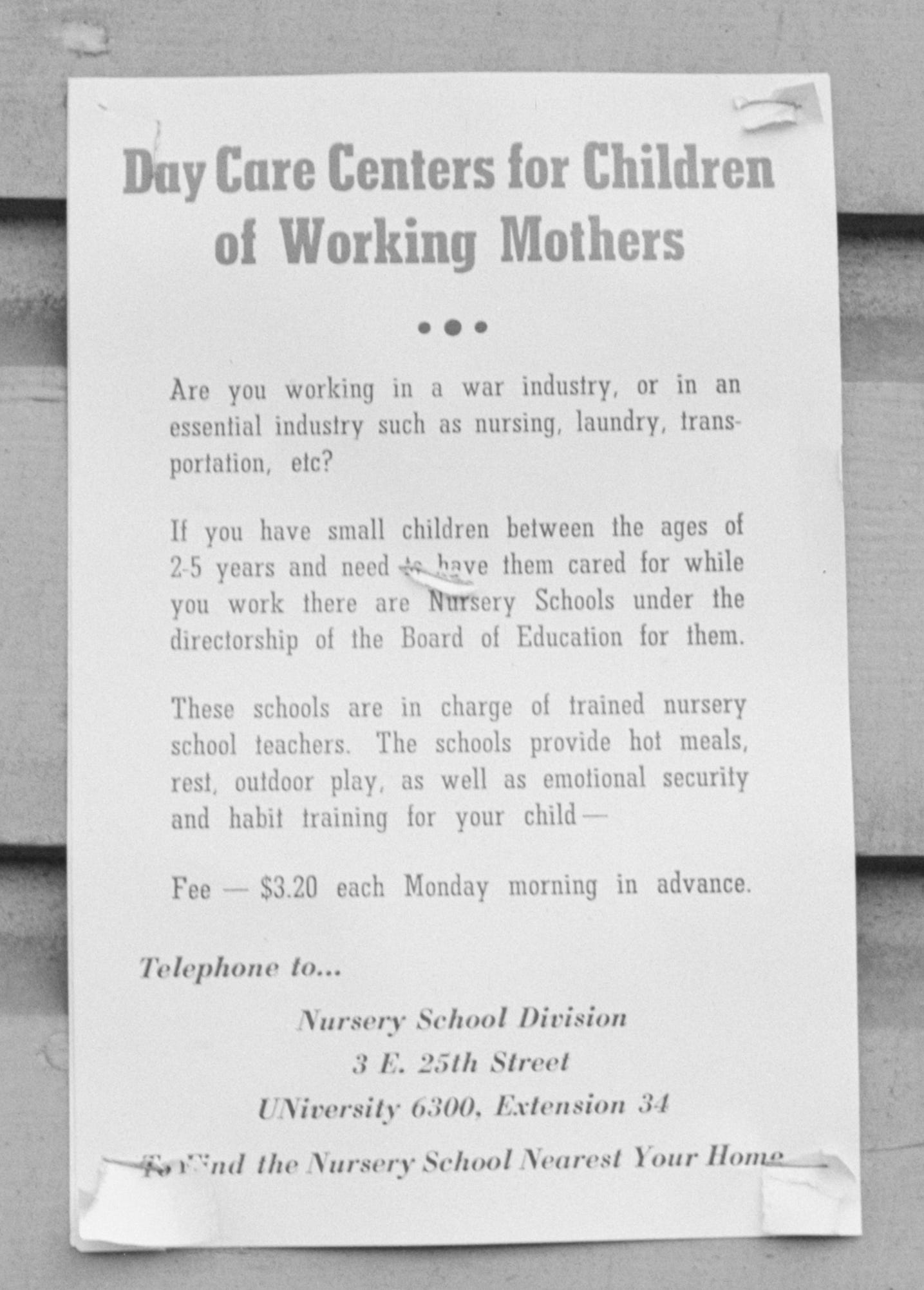
In 1943, millions of men had shipped off to war, and the U.S. government suddenly had a problem: it desperately needed workers in the factories, and the only untapped labor pool was women, including mothers of young children. So Congress did what governments do when they actually want something to happen: they write checks. We invested in child care.

Through the Lanham Act, the federal government built a nationwide network of child care centers from the ground up, with well-trained caregivers, availability six days a week, twelve hours a day, open to any working mother regardless of income. By late 1944, you could send your two-to-five-year-old to a quality child care center, meals and snacks included, for fifty cents a day, roughly ten dollars today. In total, the government invested $52 million, over a billion dollars in today’s money, and the program served more than half a million children.
Women’s workforce participation surged. Factories hit their production targets. Businesses kept their doors open. The economy, under extraordinary pressure from the wartime effort, held.
Betting on child care worked.

So, what the hell happened?
When the war ended, policymakers didn’t look at this humming, successful child care infrastructure and say, this is working, let’s keep it. The men were home, they needed their jobs back, and women were competing for them. So the Lanham Act was repealed, the centers shuttered, and a propaganda machine kicked into gear to send women back to the home. For the next eight decades the message was clear: child care is your problem, moms. Figure it out yourself.
That specific, deliberate, political decision is one we are still paying for today. Child care costs now exceed rent in all fifty states. More than half of parents are going into debt to afford it. And 500,000 women did the math last year and concluded they had no other option but to abandon their careers.
I hear the critics when it comes to action. I’ve been hearing them for years. It’s too expensive. It’s too complicated. The government can’t run something like this. Where’s the money going to come from?
Do you think the “greatest generation” got their name because they hemmed and hawed at the big scary problems that needed to be solved? We call them that because they rolled up their sleeves, got to work, and carried an unflinching belief that they could succeed.
And we have something they didn’t: hindsight. We know exactly how to pull this off. We have the receipts. We ran the experiment, and the findings were crystal clear. Affordable, accessible, high-quality child care gives mothers freedom of choice, keeps businesses productive, and strengthens the economy. We are willfully failing an open-note test.
The naysayers are making a political choice about whose crisis matters, and who is allowed to suffer. They need us to believe that the United States is less resourceful, less innovative, and less powerful than we are. I feel sorry for their lack of imagination and, quite frankly, their lack of juice.
We mobilized an entire wartime economy in a few years. We built the interstate highway system. We put a man on the moon. We created the internet. And, yes, we already solved child care. 80 years later, we could do it again, if we really wanted to.
While you are here…

A Room Where History Has Always Been Made
For decades, Gloria Steinem’s Upper East Side apartment in New York City has been a gathering place for organizers, writers, and women asking hard questions about what comes next. This summer, we’re bringing No Country for Mothers into that space.
On July 9, Gloria will host an intimate Talking Circle on the theme of America at 250: Reimagining Motherhood in the U.S. and we’re inviting five screening hosts from across the country to join us.
If you’re planning to host a screening of the film with at least 10 RSVPs by June 11, you’re eligible to submit this interest form and tell us about the gathering you’re creating.
In case you missed it…
Last week, I was honored to join Open to Debate to discuss modern parenting with host Nick Gillespie, Editor-at-Large at Reason, Lenore Skenazy, Co-founder of the Free-Range Kids movement, and Kristin Gallant, Co-founder of Big Little Feelings. And we got into…everything!
To me, the question isn't really about which parenting style is best. I’m more interested in asking why we've built a society that makes it nearly impossible to show up for your kids in the first place. From childcare costs that exceed the mortgage to school schedules that end hours before the workday does, I believe American motherhood is broken by design. Until we fix that structure, we're just arguing about the wrong things.
Give the full debate a watch on YouTube, or read the transcript + learn more on Open to Debate ‘s Substack.
Thank you for this powerful history lesson! We already solved this and then abandoned it. Bad move on levels.